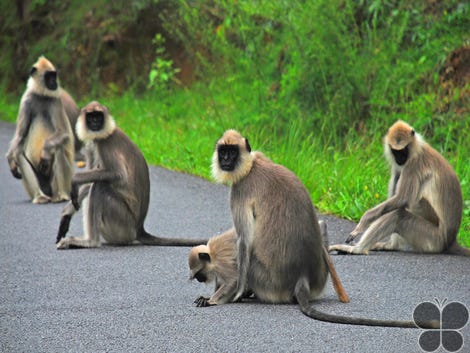
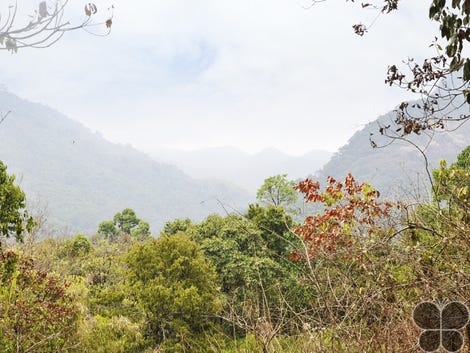
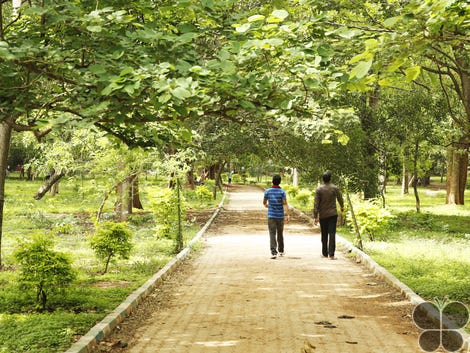
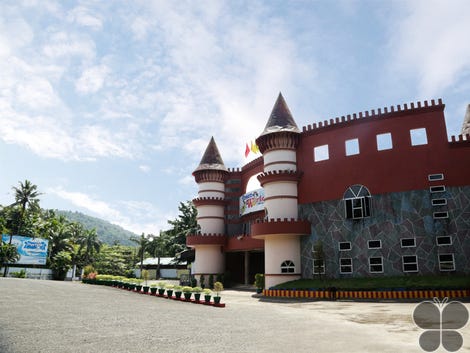
Nagarhole National Park, is a national park located in Kodagu district and Mysore district in Karnataka state in South India. This park was declared the thirty seventh Project Tiger tiger reserve in 1999. It is part of the Nilgiri Biosphere Reserve.
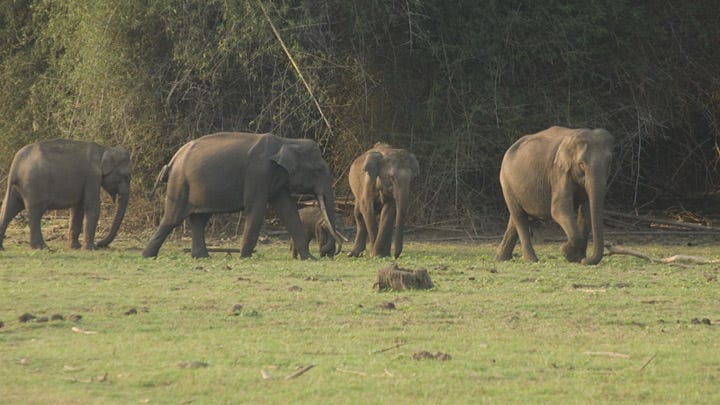
Reptile enthusiasts should look for mugger crocodiles, Indian rock pythons, Russell’s vipers, common kraits, rat snakes, and bamboo pit vipers here. Huge herds of beautiful elephants can be seen dotting the horizon on the banks of the Kabini river, forming the largest congregation of Asiatic elephants in the world.
Kabini is one of the few places where one can observe the magnificent Gaur, also known as the Indian Bison for long periods of time, and very often at close quarters. The best time to visit the Kabini Wildlife Sanctuary, Karnataka is between October and May. During summer, animals in large numbers gather near the lake. It is advisable not to visit the sanctuary between June and September as the region experiences heavy rainfall during this time of the year.
Grizzled Squirrel Wildlife Sanctuary, Srivilliputhur, Tamil Nadu.
Situated within the Western Ghats, Shenbagathoppu Grizzled Squirrel Wildlife Sanctuary was established in the year 1989 as a protected forest for the conservation of rare species of Grizzled Squirrel. Shenbagthoppu Grizzled Squirrel Wildlife Sanctuary is located in the state of Tamil Nadu and is shared between the districts of Virudhunagar and Madurai. The sanctuary is also known as Srivilliputhur Wildlife Sanctuary and covers a wide expanse of dense forests covering an area of 485 square kilometers.
Grizzled Squirrel Wildlife Sanctuary has a rich avian population that will thrill bird watchers. Over 200 species of birds have been reported here including some really rare ones like the Red Faced Malkoha, Nilgiri Flycatcher and Malayan Night Heron. Chances of spotting the Great Pied Hornbill are quite high since they are fairly common here. If you are lucky you could catch a glimpse of some mighty raptors like Serpent Eagle, Hawks and Black Eagle.
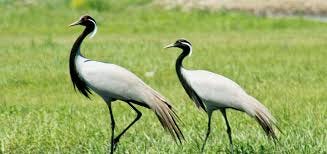
Ghataprabha Wildlife Sanctuaryspreads over an area of 20.78sq.km; this sanctuary is known for birds like crane and European white stork.
Distance: Located near Belgaum area of Karnataka, India.
Flora and Fauna:
Flora: Ghataprabha Wildlife Sanctuary consists of swampy and marshy vegetation. This Sanctuary contains many endangered species.
Fauna: Birds like crane and European white stork are seen here.
Best time to visit: Between October and May.
Mammals are also found including Jackal, Wild Boar, Indian Porcupine, Indian Pangolin, Small Indian Civet, Common Palm Civet, Grey Mongoose, and Jungle Cat. Reptiles found here are Monitor Lizard, Indian Pond Terrapin, Forest Calotes, Spectacled Cobra, Russell ’s viper, Saw-Scaled Viper, Rat Snake and others.
About: It is known to be one of the oldest sanctuaries in Telangana. In the year of 1952, on 30th January, the erstwhile Hyderabad Government declared it as sanctuary for its rich bio-diversity. Most of the statuary place is plain and one fourth is hilly. Godavari River passes through the sanctuary. For every two years, Sammakka Saralamma Jatara takes place here in a grand way.
Distance: The distance of this Eturnagaram Wildlife Sanctuary from Hyderabad is about 200 km and from Warangal about 55 km.
Park specifications : It is coverage areas about 812 km,Here Tigers, Panthers, Gaur, Sambar,Cheetal, Nilgiri and Blackbuck are the main attraction of the park.
Eturnagaram Wildlife Sanctuary is also the abode of animals such as the sloth bear, sambar, black buck, wolf, tiger, wild dogs, chousingha, chinkara, giant squirrel, four horned antelope, jackal, panther and many different species of birds. You will also see reptiles like the python, kraits monitor lizard, crocodile (mugger), cobra and star tortoise.
Dandeli Wildlife Sanctuary in uttarkannada district of Karnataka is the heavenly abundant with rich flora and fauna. The area is also rich in bamboo. These wildlife sanctuaries are scattered throughout the country and they with their amazing rock formation, diverse flora and fauna and beautiful landscapes attract the attention of the tourists from far and wide. Dandeli wildlife sanctuaryoffers wide range of adventurous activities such as one can plan for a trip to a family trekking which is designed especially taking into consideration people of age. All the family members can take part in trekking as it is designed in such a way.
Apart from doing trekking the tourists can also take part in another thrilling but entertaining adventurous activity, i.e. wildlife safaris and adventure camps. These types of tour are very exciting and breathtaking as you come in direct contact with the wildlife. The wildlife sanctuaries try to provide a natural atmosphere and keep the animals, reptiles, birds and endangered species in their natural ambience.
Dandeli Wildlife Sanctuary is inhabited by wildlife like deer, sloth bear, elephant, black panther, tiger, wild dog, gaur, langur, jackal, bison, slender loris and giant flying squirrel. The forest authority of the Dandeli National Park offers wildlife safaris in jeeps to the tourists visiting here. The safari in an open jeep will take you closer to the jungle where you can watch wild animals in their natural habitat. There are a good number of reptiles including the king cobra, iguana and crocodile as well as amphibians in and around the sanctuary. There is an exclusive crocodile park here. Dandeli Wildlife Sanctuary is a bird watcher’s paradise known to inhabit more than 300 species of birds including 4 species of hornbills. Hornbills stand testimony to the fact that the dense forests are rich in flora as these birds need more than twenty varieties of fruits for their survival.
Coringa Wildlife Sanctuary (CWS) is one of the Wildlife Sanctuaries in Andhra Pradesh. It is located in East Godavari District of Andhra Pradesh. It is approximately 20 km (12.42 miles) away from Kakinada, Headquarters of East Godavari District.
History of the Coringa Wildlife Sanctuary
History of the CWS starts from the year 1978. This wildlife sanctuary was established by government of Andhra Pradesh on July 5, 1978. At present this sanctuary is under the governance of Andhra Pradesh Forest Department.
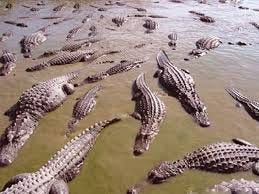
Another interesting species that you could possibly spot in Coringa Wildlife Sanctuary are estuarine crocodiles, along with fishing cats, golden jackals, sea turtles and smooth-coated otters.
Planning a trip between the months of January and March would make your trip doubly interesting as this is the nesting period for the endangered olive ridley sea turtles who lay their eggs in the long sand pit by the estuary.
The Coringa Wildlife Sanctuary is a unique destination choice, especially if you have an unusually heightened curiosity about fragile eco-systems such as mangroves. The pleasant weather and lush trees and floral life are the perfect welcome to all travelers, kids included, who are in for a very educative and memorable trip.
The Coringa Wildlife Sanctuary opens at 9 AM. The forest area here is called the Mada Forest. Coringa sanctuary is located around the estuary formed by a branch of the Gautami River, a distributary of the Godavari as it meets the sea at Coringa sanctuary. It is also the one of India’s largest mangrove forests.
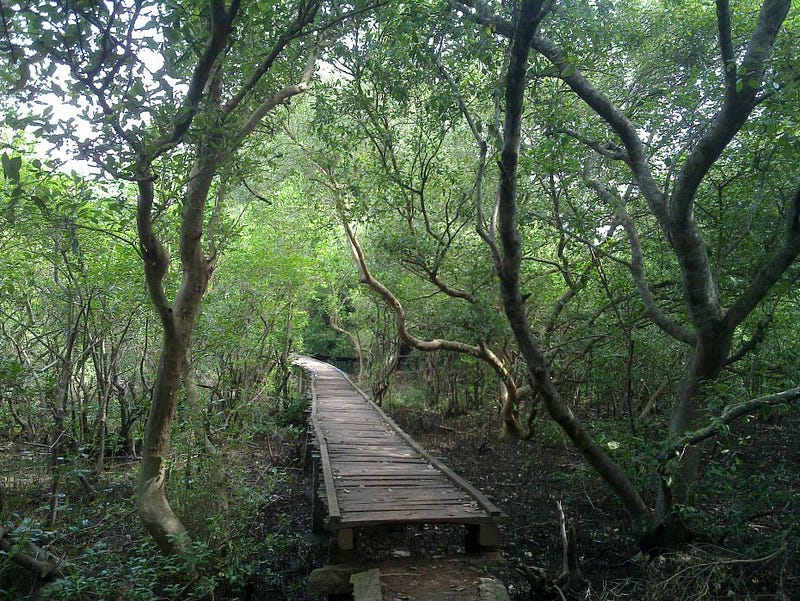
Even on a Sunday, the sanctuary was empty. The authorities have built a wooden ramp to walk around the forest.
A walk in the forest is an experience to remember. There is absolute silence except for the sounds of the forest. The ramp stretches for 1 &1/2 kms around the forest and in some places passes through branches of huge trees.Coringa Wildlife Sanctuary is famous for reptiles and crocodiles. Salt-tolerant plant species comprise the flora here. The fauna, not to be left behind, is no less here. One can see Fishing Cats, Otters, Jackals, Estuarine Crocodiles, Sea Turtles, Sea Gulls, Pelicans, Storks, Herons, Snipes, Flamingos, to name only a few. The sanctuary has over 125 species of birds that include the crested serpent eagle, scarlet minivet, Indian roller, black capped kingfisher, oriental dwarf kingfisher and white bellied woodpecker.
Located at eastern Thrissur District, it shelters several endemic and endangered species within 86 square kilometres bound.
Chimmony joins Peechi-Vazhani and Parambikulam wildlife sanctuaries to form a contiguous biosphere of 210 Sq. Kms. Habitat continuity facilitates uninterrupted wildlife movements and increased diversity.
Moist deciduous forests take up more than half of Chimmony landscape, while tropical evergreen and semi evergreen forests fill the rest.
Starting from 40 m altitude, eastward slant escalates to hit zenith at Punda peak, 1116 m from sea level.
Temperature reaches to a low 15 Centigrade in January.
If you have kids in tow, let them enjoy the Children’s Nature Walks. These are designed to enhance awareness about eco-systems among young ones. Nature camps too are conducted in Chimmony Wildlife Sanctuary for the students of Government recognized educational institutions and NGOs involved in ecological preservation.
Bhimgad Adventure Camp at Khanapur is located close to the Western Ghats and within a two-hour drive from Goa, Kolhapur and Hubli. It is named after the Bhimgad Wildlife Sanctuary which is known for the rare Wroughton’s Free-tailed Bat.
While staying at Bhimgad Adventure Camp, you can explore parts of the Western Ghats. You can also go for a nearby forest and water stream, indulge in birdwatching — and be treated to beautiful birds like the Velvet-fronted Nuthatch, Malabar Grey Hornbill, Imperial Pigeon, Emerald Dove or perhaps even the elusive Malabar Trogon.
one can explore Belgaum fort, a scenic view from Rajhamsh Fort, try your hand on Pottery making at Pottery Institute and a water falls like Sural falls, Amboli falls and Gokak falls on your own interest
Reputed as a part of two vital tiger corridors, Bhimgad forests link the Dandeli Wildlife Sanctuary and Radhanagri Wildlife Sanctuary in Maharashtra and the other links Dandeli and the Mollem Wildlife Sanctuary.
Bhimgad Wildlife Sanctuary has a bit of both tropical and subtropical moist broadleaf forests and grasslands. The sanctuary is rich in medicinal plants as well.
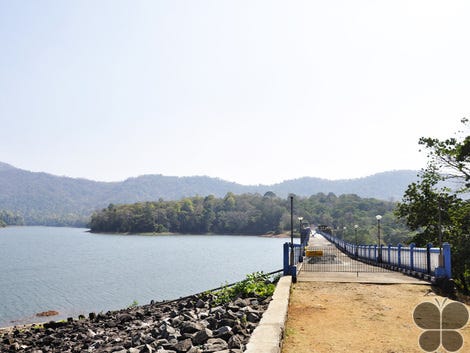
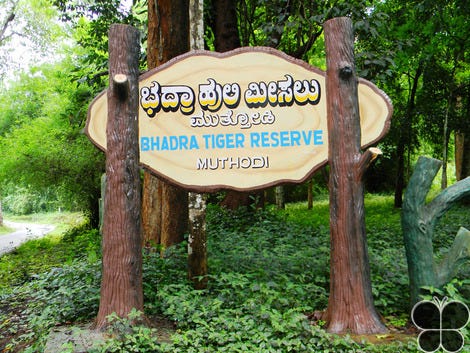
Bhadra Wildlife Sanctuary situated in the midst of Western Ghats in Chikmagalur and Shimoga districts of Karnataka. This sanctuary is covering an area of 492.46 sq. km.
Bhadra Wildlife Sanctuary is located at a distance of 38 km northwest of Chikmagalur town. The sanctuary is surrounded by Mullaianagiri, Hebbegiri, Gangegiri and Bababudangiri hills and has the tributaries like Somavahini, Thadabehalla and Odirayanahalla of the Bhadra River flowing through it.
Bhadra Wildlife Sanctuary gets its name from the river Bhadra. Bhadra Wildlife Sanctuary is also popularly known as Muthodi Wildlife Sanctuary, after the village on its periphery. The reserve consists of two main areas, Muthodi and Lakkavalli.
The area was declared as “Jagara Valley Wildlife Sanctuary” in 1951 by the Government of Mysore. The Sanctuary was reconstituted in the year 1974 as “Bhadra Wildlife Sanctuary”.
The forest type is southern tropical dry deciduous dry teak, Northern tropical dry deciduous mixed forest, Dry deciduous scrub forest, Boswellia forest, Dry bamboo brakes, Anogeissus pendula forest.
More than 120 tree species grow here, which include Teak, Rosewood, Mathi, Honne, Nandi, Tadasalu and Kindal.
A diverse range of wildlife is found in the sanctuary like elephant, gaur, tiger, panther, sambar, spotted deer, mouse deer, barking deer, sloth bear, wild boar, wild dog, mongoose, porcupine, jackal, and the common langur.
Apart from the 33 tigers that Bhadra is famous for, other mammalian inhabitants include elephant, gaur, sloth bear, wild boar, leopard, jungle cat, jackal, wild dog, jackal, sambar, and spotted deer, barking deer, mouse deer, common langur, bonnet macaque, slender loris, small Indian civet, common palm civet, pangolin, porcupine, flying squirrel and the Malabar giant squirrel. You can also come across small carnivores like leopard cat, rusty-spotted cat, ruddy mongoose, triped-necked mongoose and otters. The Sanctuary was earlier famous for Indian bison or Gaur, which numbered more than a thousand. Rinder pest disease took a heavy toll on these animals during 1998–99. The park has a horde of reptiles like vine snake, king cobra, common cobra, Russell’s viper, bamboo pit viper, rat snake, olive keelback, common wolf snake, common Indian monitor, draco or gliding lizards and marsh crocodiles. Bhadra Wildlife Sanctuary has more than 300 species of birds, including those endemic to this region and some migratory birds. The rich avian population is a source of delight for tourists. Some of the species found in Bhadra are grey jungle fowl, red spur fowl, painted bush quail, emerald dove, southern green imperial pigeon, great black woodpecker, Malabar parakeet and hill myna, ruby-throated bulbul, shama, Malabar trogon, Malabar whistling thrush, four species of hornbill and racquet-tailed drongo. Adding color and variety to the rich fauna here are the petite multihued butterflies, which enthrall children and persons with an artistic bent of mind. Butterflies like yamfly, baronet, crimson rose butterfly, southern birdwing, tailed jay, great orange tip, bamboo tree brown, and blue pansy are found here.
The district of Wayanad lies on an elevated picturesque mountainous plateau in the Western Ghats. Historians are of the opinion that organised human life existed in these parts of Kerala at least ten centuries before Christ. In this virgin land, which has not seen much human habitation later, is Begur. The forests here are amongst the most beautiful locales of Kerala. The region has a wealth of diverse species of plants and animals and is of great interest to nature lovers. The Begur Wildlife Sanctuary is situated about 20 km east of Manathavady in Wayanad.
Getting there
Nearest railway station: Thalassery in Kannur district is about 80 km from Mananthavady
Nearest airport: Calicut International Airport, about 106 km
The Begur Wildlife Sanctuary is a treat for wildlife enthusiasts and photographers. Enthusiastic trekkers will find several trekking routes in this sanctuary. Numerous folk festivals are celebrated during the months of February and March. Folk dances of the tribes are an important part of festivities at Begur Wildlife Sanctuary.
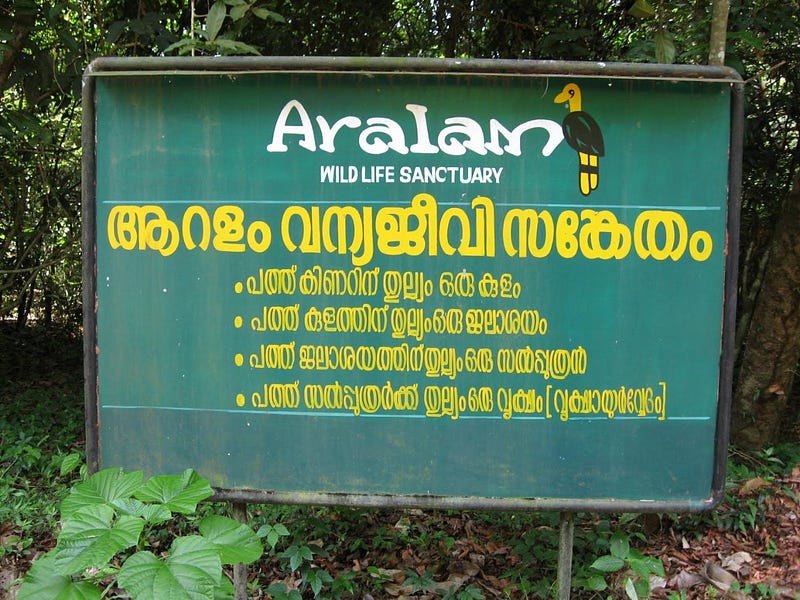
Aralam Wildlife Sanctuary is the northernmost wildlife sanctuary of Kerala, southwest India. It is 55 km² in area and located on the western slope of the Western Ghats. It was established in 1984. The headquarters of the sanctuary is near Iritty.
Aralam Sanctuary conducts Nature Camps, primarily for students. These have become so popular now that about 60 camps are conducted annually. These camps, which are two-day or three-day camps allow for about 40 kids per camp. Adults interested in Nature Camps will need permission from the Chief Conservator of Forests. Incidentally, you cannot smoke or drink liquor within the sanctuary; plastic bags are banned too.
Do stop over at the Central State Farm which is next to Aralam Sanctuary and see the government’s initiative in researching and developing hybrid coconuts. The farm extends over 3000 hectares.
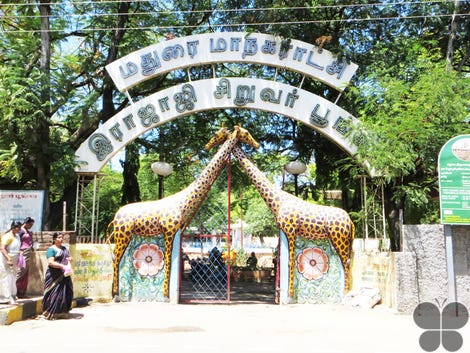
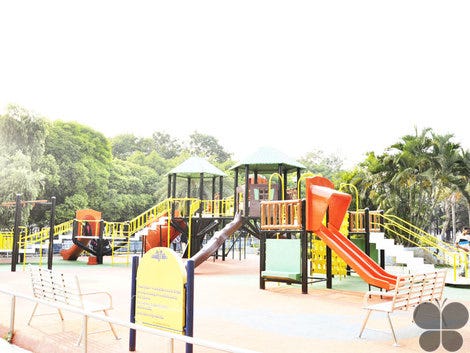
The rajaji children park is a best children park in madurai. The rajaji park was beautiful location. The park was cleanly and very best maintaining place in madurai.one of the best entertainment place in madurai.people attractive place in madurai.The growth of rajaji park is outstanding
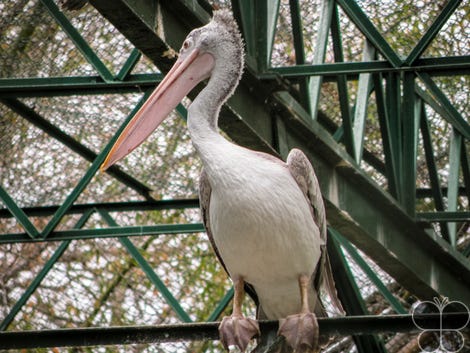
Rajaji Children’s Park in Madurai is a popular spot for families with kids. Located between the Gandhi Museum, and the Tamukkam grounds, 2 kms from the Central Bus Stand, the park has play equipment for kids, some eateries and hotels and a collection of birds.
Rajaji Park is owned and maintained by the Corporation of Madurai and is open daily from 10am to 8pm.
Bannerghatta National Park, near Bangalore, Karnataka, was founded in 1970 and declared as a national park in 1974. In 2002 a portion of the park, became a biological reserve, the Bannerghatta Biological Park.
A mere 22 kms away from the urban jungle that is Bangalore (Bengaluru) is Bannerghatta National Park. This natural reserve spans 25,000 acres and comprises of 10 forest reserves of the Bangalore Forest Division. The Bannerghatta National Park, a Safari Park, a serpentarium, a Butterfly Park, a museum, a park of pre-historic animals and not to forget, the famous Bannerghatta Zoo form a large part of this National Park.
One of the famous Hyderabad tourist places, Lumbini Park Hyderabad was developed by the Hyderabad Urban Development Authority in the year of 1994. Perfect place for relaxation and amusement, Lumbini Park has been named after birthplace of Siddhartha who later came to be known as Lord Buddha. The park is part of the Buddha Purnima project of Hyderabad Urban Development Authority.
After the later Chief Minister of Andhra Pradesh, this park was renamed at the T. Anjaiah Lumbini Park in the year of 2006. However, popularly it is still known by the name of Lumbini Park.
On August 25, 2007, a series of bomb blasts in Hyderabad killed 44 people and injured 60. One of the two blasts occurred during the evening hours in the laser auditorium that housed about 500 people at the time of the incident. After a few days of being cordoned off for crime scene investigation, the park was reopened to the public after the installation of metal detectors.
The Moyar River, which snakes through the jungle, is the lifeblood of the teeming fauna here and is also the border between Bandipur and the Madumalai Sanctuary.
Bandipur National Park, an 874-sq.-km forested reserve in the southern Indian state of Karnataka, is known for its small population of tigers. Once the private hunting ground of the Maharajas of Mysore, the park also harbors Indian elephants, spotted deer, gaurs (bison), antelopes and numerous other native species. The 14th-century Himavad Gopalaswamy Temple offers views from the park’s highest peak.
The open lush woodlands are like a picture postcard come alive with stunning landscapes bordered by mist-kissed mountains, deep gorges and thick forest.
The Silent Valley National Park with an area of 237. 52 sq km is located in the Northeastern corner of Palakkad district. It rises abruptly to the Nilgiri Plateau in the North and overlooks the plains of Mannarkkad in the South. Extremely fragile, a unique preserve of tropical evergreen rain forests which is a veritable nursery of flora and fauna, some of which are found nowhere else in the world.
The core of the Nilgiri Biosphere Reserve is the Silent Valley National Park. Despite its name, the Silent Valley (the clamour of Cicadas is conspicuously absent here) is a rich storehouse of biodiversity. It is a true Garden of Eden for students of life sciences, professional scientists and field biologists.
The Silent Valley National Park (Sairandri) is one among very few places on earth that has absolutely no history of human inhabitation. Also, it is one of the last remaining rainforests and tropical moist evergreen forests in India. The British named it Silent Valley for a very simple reason — that it lacked the presence and loud chorus of cicadas. It is an undisturbed tract located in the south of the Western Ghats in Kerala. For the very reasons that it is unique, the Silent Valley National Park attracts much attention — from curious visitors as well as hard core trekkers. Its forests span nearly 240 square kilometers and are juxtaposed with several habitats. It is widely considered as one of the most diverse in terms of ecology and biodiversity. It is no surprise that the highest peak in Pallakkad district is also situated here.
The Cubbon Park, officially known as Sri. Chamarajendra Park, is an historic park, located in the heart of city in the Central Administrative Area. The park provides sylvan surroundings to the State Legislature building- the Vidhana Soudha, the High Court Buildings — the Attara Kacheri and a number of other organizations located along the periphery and within the park which constitute the Central Administrative Area.
Historical Background
The Cubbon Park has a history of over 100 years. It was established in the year 1870 by Sri John Meade, the then acting Commissioner of Mysore. The vast landscape of the park was conceived by Major General Richard Sankey, the then Chief Engineer of the State. As a mark of honour to Sri John Meade, the park was initially named as “Meade’s Park” and subsequently it was called the Cubbon Park. Since the inception of the park, it was developed and improved by adding new structures and features. In the year 1927, the park was officially renamed as “Sri. Chamarajendra Park” to commemorate the Silver Jubilee of Sri. Krishnaraja Wodeyar’s rule in Mysore State.
Cubbon Park is under the control of the Department of Horticulture. The Deputy Director of Horticulture (Cubbon Park) is responsible for the administration and maintenance of the park.
The landscaping in Cubbon Park very creatively integrates natural rock outcrops with thickets of trees, massive bamboos, grassy expanses, flower beds and monuments, which are all regulated by the Horticulture Development of the Government of Karnataka. The park has many motorable roads and well laid pathways that are frequented by naturalists and early morning walkers alike.
Periyar National Park, also known as Periyar Tiger Reserve, is in the mountainous Western Ghats of Kerala, southern India. This wildlife sanctuary is home to tigers and a significant elephant population, as well as rare lion-tailed macaques, sambar deer, leopards and Indian bison. In the park’s north, Periyar Lake is popular for boat rides. Farther north, spice plantations surround the town of Kumily.
The boat cruises are open from morning 7 AM to afternoon 4 PM and are of approximately two hours duration. The boat cruises are operated by KTDC and the forest departments. For an Indian tourist wanting to cruise on the upper deck of a boat will cost him Rs. 100, while the lower deck is charged at Rs. 75.
Positioned close to Athirappilly Waterfalls, a prominent park Dream World Water Park is located. This park is located close to the picturesque destination Thrissur district. This water park is gaining a lot of popularity among tourists. This artificial water park is built amidst nature’s bounty. The famous Athirappilly Waterfall is located close by. Visitors love to visit these two places, though one natural and one artificial yet both have something unique to offer. The water park welcomes visitors coming here with gigantic dragons positioned at the entrance close to the main gate. Since it is a water park, there are many rides, some water based that excites both children as well as adults.
Other water rides at Dream World Park include Dream Shower, Space Bowl, Crazy Cruize, Mat Racer, Wave Pool, Amazon River, Dream Splash, Lazy River, Infant Pool, Aqua Shuttle and Boomerang. If you don’t want to get your feet wet…well, there are always the dry rides. These include Striking Car, Sky Train, Flying Columbus, Dynamo Hockey, Computer games,
Caterpillar, Dragon Train, Revolving Barrel, Crescent Coaster, Family Swing and Twister.